Fake Purchase Order Scams: How to Spot a Fraudulent RFQ Before You Ship
The short version
A fake purchase order scam tricks a supplier into shipping real goods on credit to someone who will never pay. You can spot one before you ship by checking three things outside the email: the sender’s domain, where replies go, and the delivery address.
The scammer poses as a buyer you’d be glad to win, often a university, hospital or big brand. They ask for a quote, then send a convincing PO on 30-day terms with a delivery address that isn’t theirs.
It works on sales teams because it looks exactly like what they want: a big order from a name they recognize. Nobody wants to be the rep who grilled a real customer.
The FBI’s IC3 put business email compromise losses at almost $3.05 billion in 2025, second only to investment fraud. Purchase order fraud is one branch of that, and it hits small and mid-sized suppliers hardest, where one shipment can be a month’s margin.
Below, you’ll find how the scam runs, the red flags at each stage, and a checklist for before you quote and before you ship. We also cover where automated screening helps and where it stops.
How the fake purchase order scam works
The FBI’s write-up of purchase order fraud describes a pattern that hasn’t changed much in a decade. What’s changed is the polish.
-
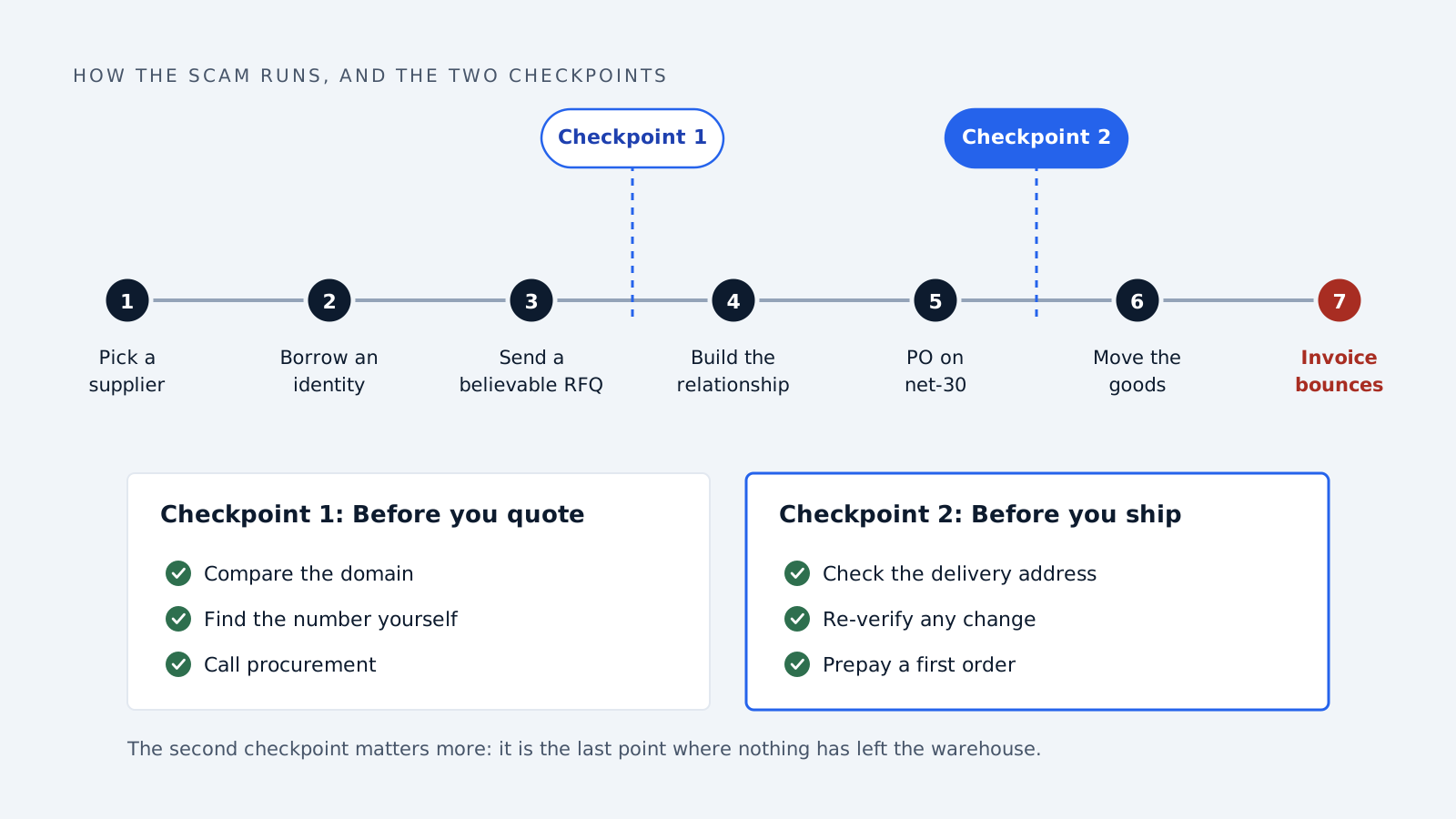
Pick a supplier. Scammers comb trade directories, exhibition catalogs and company websites for sales contacts. Smaller vendors make good targets because one big order matters to them, and they often offer trade credit.
-
Borrow a buyer’s identity. They register a lookalike domain and copy the real organization’s letterhead, sometimes down to the name of an actual procurement manager. A 2026 campaign impersonating Pfizer cycled through domains like pfizersupplies[.]com and pfizertenders[.]com, dropping each one once it was blocked.
-
Send a believable RFQ. It has a reference number, product codes, a realistic quantity and a quote deadline. The Pfizer variant asked for 46 units of one pump model. Details like these feel like internal planning, so your team starts pricing instead of asking questions.
-
Build the relationship. A few polite emails about lead times and warranty follow. Each reply you send makes you more invested in the deal.
-
Issue the PO on credit. The PO asks for net-30 terms, which suppliers grant because the real organization has good credit. The delivery address is a warehouse, a freight forwarder, a self-storage unit, or the home of someone recruited through a fake job or romance scam.
-
Move the goods. Within days, someone picks up the shipment or forwards it, often overseas.
-
The invoice bounces. Thirty days later, you bill the real organization. It has never heard of you.
Some versions skip the goods entirely and ask for a “supplier registration fee,” tax forms, bank letters, or a login on a fake supplier portal. That last one turns a fake order into a hacked mailbox.
Red flags, stage by stage
No single flag proves fraud. Two or three together should stop the deal until someone checks it outside the email thread.
| Stage | Red flag | Why it matters |
|---|---|---|
| Sender | Domain is close to, but not exactly, the buyer’s real one (extra hyphen, “-supplies”, “-procurement”, a regional word) | Anyone can register a domain containing a brand name |
| Sender | Reply-To differs from From, or replies are steered to a new address | The scammer needs your replies to reach them, not the real company |
| Sender | A university or public body writing from a domain that isn’t its .edu or .gov | The FBI flags this as one of the clearest tells |
| RFQ | A large first order from a buyer you’ve never qualified | Real procurement usually onboards a new supplier first |
| RFQ | Generic or high-resale goods: laptops, drives, lab equipment, pumps, medical items | Easy to resell once shipped |
| RFQ | Phone number in the signature goes to voicemail or nobody | The only number they give you is one they control |
| PO | Net-30 terms requested on a first order | The goal is goods now, payment never |
| PO | Branding is perfect, but nothing on it can be checked independently | Logos and addresses are copied from public pages |
| Shipping | Delivery address isn’t one of the buyer’s locations: a home, storage unit or freight forwarder | The single most important check, per the FBI |
| Shipping | Address or contact changes late, after credit is approved | Late changes slip past a review that already happened |
| Shipping | Rush or overnight shipping requested | Less time for anyone to notice |
| Anytime | Fees before the order goes live: registration, tender documents, compliance | Real buyers don’t charge suppliers to sell to them |
The old phishing test no longer works
For years, the advice was to look for bad grammar. The FBI’s own list of purchase order fraud signs still includes poorly written emails from a non-fluent writer.
That test is close to useless now. Any scammer with a free chatbot can write a fluent, well-formatted RFQ in a procurement team’s house style. The Pfizer campaign above reads like a real tender, down to the reference numbers and the confidentiality footer.
What AI hasn’t changed is the setup behind the email. A scammer can fake the words, but they still need:
-
a domain they control, which won’t be the buyer’s real one
-
a way to receive your replies
-
a delivery address that isn’t the buyer’s
-
payment terms that let them take goods before money moves
So stop judging how the email reads. Check where it came from, where replies go and where the goods end up. A language model can’t fake those.
Verification checklist
There are two checkpoints: before you spend time quoting, and before anything leaves the warehouse. The second one matters more.
Before you quote
-
☐ Compare the full sender domain with the buyer’s real website, character by character. Check the From, the Reply-To and any portal links separately.
-
☐ Look the buyer up yourself, and get the procurement or main phone number from their official site, not the email signature.
-
☐ Call and ask whether they sent this RFQ, whether this person works in purchasing, and how they onboard new suppliers.
-
☐ Check whether the domain was registered recently; a WHOIS lookup takes a minute.
-
☐ Don’t send tax forms, bank letters, director IDs or signed documents until the buyer is verified.
Before you ship
-
☐ Confirm the delivery address belongs to the buyer by searching it. A warehouse, storage unit, home or freight forwarder needs an explanation from a verified contact.
-
☐ Re-verify after any change to the address, quantity, carrier or contact, using the number you found rather than the one in the thread.
-
☐ Run your normal credit check on the actual buyer, even for famous names. The reputation belongs to them, not to whoever copied their logo.
-
☐ For a first order, ask for prepayment, a deposit or a verified purchasing card instead of net-30.
-
☐ Treat a payment as real only when it clears in your own bank account. A PDF or screenshot saying it was sent doesn’t count.
If a buyer pushes back on any of this, that tells you something. Real procurement teams expect suppliers to check.
Where automated screening helps, and where it stops
We built RFQ screening into Delynt because teams skip the first checkpoint. When ten quote requests land before lunch, nobody runs a WHOIS lookup on each one.
Automation is good at the repetitive part. Every inbound request gets the same checks:
-
Is this the first contact from this sender?
-
Does the domain match the organization it claims to be?
-
Is the domain new?
-
Do the Reply-To and From addresses match?
-
Does the request show the patterns above?
Each email gets a trust score and a spam score with the reasons written out, so a rep sees why something was flagged, not just a number.
Automation stops at the second checkpoint. Software can tell you an address looks like a self-storage facility, but it can’t phone the real procurement office, and it shouldn’t approve credit.
A high trust score means “this looks like a normal inquiry,” not “this buyer will pay.”
Our recommended split is simple. Let the system screen every inbound request and flag the risky ones, but keep a person on credit terms, large first orders and delivery address changes. See how the screening works.
If you’ve already shipped
Move fast: the FBI notes that if you report the theft before the goods leave the country, there’s a chance of getting them back.
-
Call the carrier now. Ask them to hold or reroute the shipment if it hasn’t been delivered or picked up.
-
Contact the real organization through its official number. Report the impersonation and confirm the order was never theirs.
-
Report it to local police and the FBI’s Internet Crime Complaint Center at ic3.gov.
-
Call your bank if you paid any fee or refund, and ask for a recall.
-
Secure your mailbox if anyone entered a password on a linked portal. Change it, end active sessions and check for new forwarding rules.
-
Warn your customers that your quotes and letterhead may be reused to impersonate you. Tell them how to verify a payment change.
-
Keep everything: emails with full headers, PDFs, phone numbers, the delivery address and shipping records.
FAQ
What is a fake purchase order scam? It’s a fraud where someone poses as a real buyer, often a university or large company. They get a supplier to ship goods on credit, usually net-30, and send the shipment to an address they control. The goods are gone within days, and the supplier is never paid.
How can I tell if a purchase order is real? Check it outside the email: find the buyer’s phone number on their official website and call their procurement team. Confirm the order, the contact person and the delivery address. A PO can copy a real logo and letterhead perfectly, so its formatting proves nothing; the phone call and the address check are what count.
Why do scammers ask for net-30 terms? Credit terms let them take the goods before any money moves, and suppliers often agree because the real organization has good credit. By the time the invoice is due 30 days later, the scammers have collected the shipment or sent it overseas. For a first order, ask for prepayment or a deposit instead.
Are universities really targeted? Yes, because suppliers trust universities and sell to them on credit, which makes them good cover. Edinburgh, Toronto, Auckland and UMass have all published warnings to suppliers about fake POs issued in their name. If a university contacts you from a domain that isn’t its official one, treat it as a red flag.
Can a perfect, well-written email still be fake? Yes. AI tools have made spelling and grammar useless as a warning sign, since scammers can now write a fluent RFQ in a real procurement team’s style. Check the things a language model can’t fake: the sender’s domain, where replies go and where the goods are being shipped.
Can AI detect fake RFQs? It can screen every inbound request for technical signs, such as lookalike domains, mismatched reply addresses and first-time senders. Then it flags the risky ones with the reason written out. What it can’t do is replace a phone call to the real buyer before you extend credit or ship goods.
Sources
How we write, source and correct our articles:editorial policy.
Related reading
AI for Freight Brokers: Where It Wins Loads, and Where It Doesn't
Big brokers answer email quotes with AI in two minutes. What a small brokerage can automate today, where AI catches freight fraud, and what to keep human.
How to Train an AI Model for Your Mid-Sized Company's Sales Team
Training AI for sales means teaching a capable model your buyers, playbook and data, not building one from scratch. Six practical steps for mid-sized teams.
Is AI Replacing CRM? No, Here's What It's Replacing
AI isn't replacing your CRM. It's replacing the manual work around it: data entry, slow lead replies, forgotten follow-ups, and guessing who to call next.
Ready when you are
See it read your own sales mailbox
Twenty minutes, on a real mailbox, with no slides. Gmail, Google Workspace, Outlook and Microsoft 365.