AI for Freight Brokers: Where It Wins Loads, and Where It Doesn't
Freight brokerage still runs on email
AI for freight brokers works best in the inbox. It sorts quote requests so reps answer faster, and it flags fraud before a load moves. It works worst when you trust it to set rates or book carriers on its own.
Freight has load boards, TMS platforms and APIs, but most spot business still starts with an email. C.H. Robinson said it gets over 11,000 emailed truckload pricing requests on an average business day. It built AI that answers 2,000 of them a day, in about two minutes each.
That sets shippers’ expectations, and a small brokerage can’t build that stack. It can still fix the part that costs it loads: the gap between a quote request landing and a person seeing it.
The same inbox is where brokerages get robbed. In Highway’s Q1 2026 Freight Fraud Index, email-based fraud made up about 26% of incidents, in a quarter when freight fraud hit an all-time high.
This post covers what works for a brokerage with a handful of reps, not a 1,000-person operation.
Five uses of AI for freight brokers, in the order we’d try them
We ranked them by how fast a small brokerage sees a result, and how little it risks if the AI gets one wrong.
| # | Use case | What the AI does | Why it ranks here |
|---|---|---|---|
| 1 | Quote request triage | Spots which emails are quote requests, pulls origin, destination, dates, equipment and weight into a structured note, and alerts the right rep | Nothing goes to the shipper without a person; pure time saved |
| 2 | Sender and carrier screening | Flags lookalike domains, first-time senders, mismatched reply addresses and rate cons from unverified contacts | Fraud is the most expensive mistake a broker makes |
| 3 | Drafted quote replies | Drafts the response with the rate from your pricing tool, for a rep to approve | Speed wins spot freight, but the rate stays your call |
| 4 | Follow-up on open quotes | Reminds reps about quotes with no reply and drafts the nudge | Recovers loads that die from silence, low risk |
| 5 | Shipper and lane insights | Answers plain-English questions about your own email and CRM history: which shippers went quiet, which lanes you lose most | Useful once the first four are running and the data is clean |
Start with quote triage. Speed matters because only so many carriers work a lane on any given day. MIT research cited by C.H. Robinson found that shippers who reach the spot market late can pay 23% to 35% more. A shipper who gets your quote second often doesn’t come back.
Keep pricing in your tools. The AI’s job is to read the request and hand it to whatever you already price with: a TMS, DAT, a rate sheet or a senior broker. If you let a language model invent a rate, you’ll lose margin without noticing.
Leave insights for last. They’re only as good as the history underneath. If half your quotes live in personal inboxes and never reach the CRM, fix that before you ask an AI which lanes make money.
Double brokering and inbox fraud: where screening helps
Cargo crime has moved from cutting padlocks to faking identities. Overhaul counted 574 U.S. cargo thefts in Q1 2026, down from late 2025. But deceptive pickup schemes, which use fake identities and carrier impersonation, rose 31% year over year.
Highway’s numbers for the same quarter show how much of this runs through email and identity:
-
Email-based fraud was about 26% of incidents.
-
Change-of-ownership fraud rose 169.6%.
-
Reported identity theft rose 89.6% year over year.
-
Carriers with real MC numbers and clean histories caused about half of all thefts.
That last point matters. Checking an MC number once isn’t enough anymore, because the authority can be real while the person behind it isn’t.
What AI screening can catch in the inbox:
-
a carrier or shipper email from a domain slightly different from the one on file
-
a reply-to address that routes somewhere new
-
a first-time sender asking for load details, rate cons or reroutes
-
a change to payment details or pickup instructions in the middle of a load
-
urgency: after-hours requests, “the driver is waiting,” pressure to skip a callback
What it can’t do: confirm who’s driving the truck, verify insurance with the underwriter, or decide whether a carrier is safe to book. Your carrier vetting tools handle that, along with a phone call to a number you already trust.
The setup is simple: every inbound message gets screened, and risky ones go to a person with the reason written out. Any change to payment, pickup or delivery details needs a callback before anyone acts on it. The same patterns show up in fake purchase order scams against suppliers.
What AI shouldn’t do in a brokerage
Some jobs look easy to automate but aren’t worth the risk.
-
Set rates on its own. A language model doesn’t know today’s capacity on a lane. Let it read and route, and let your pricing tools and your people set the price.
-
Book carriers. Tendering a load is a trust decision, with cargo and liability attached. AI can prepare the packet, but a person commits.
-
Approve changes to payment or pickup details. These are exactly what fraudsters go after. Every change gets a callback, every time.
-
Auto-send replies to new senders. A fast, friendly auto-reply to a fake shipper hands them your rate structure and your contact details.
-
Pretend to be a person. If an AI drafts or sends a message, say so where it matters. Shippers forgive automation. They don’t forgive being misled.
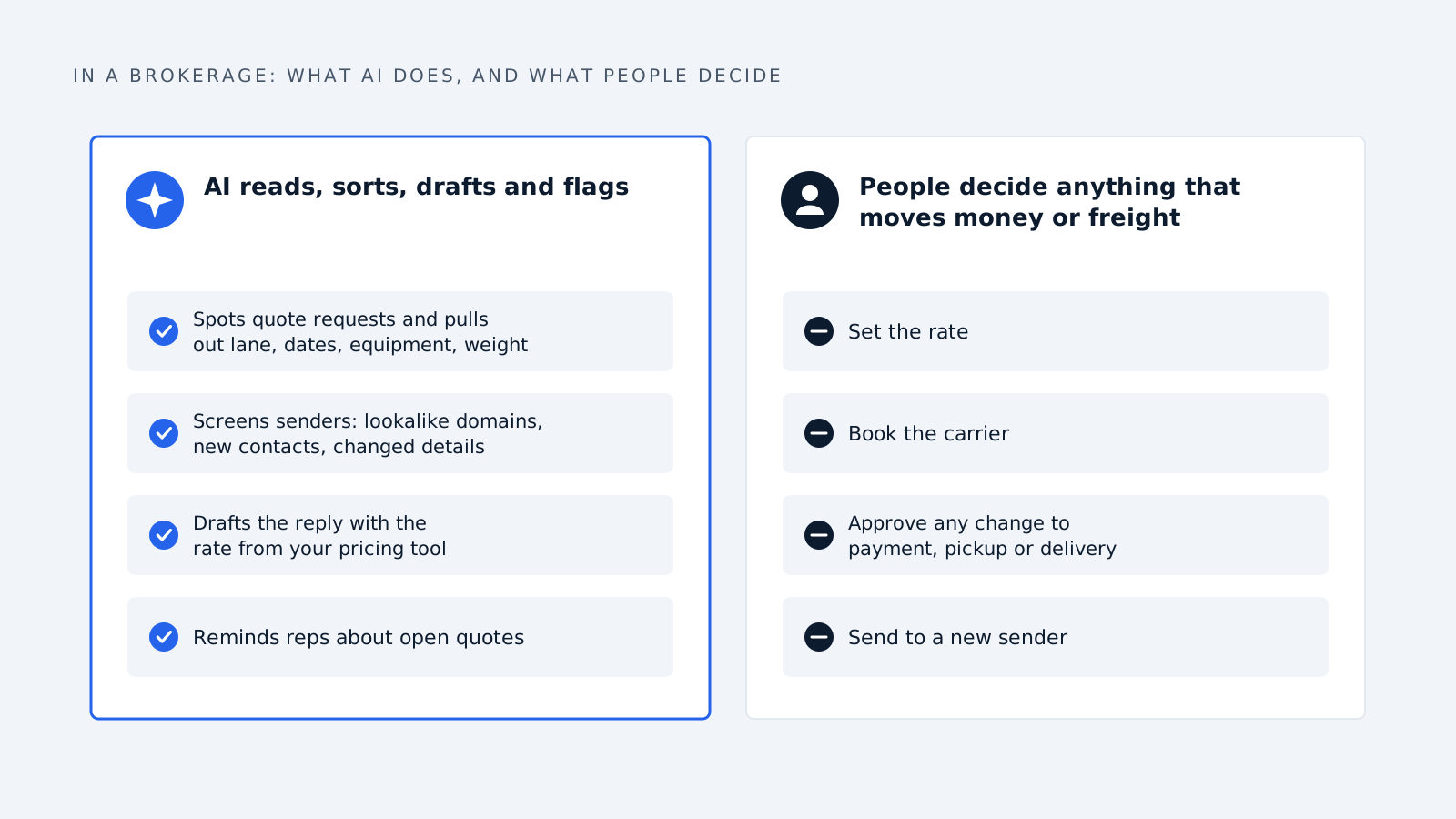
The pattern is the same across all five: AI reads, sorts, drafts and flags, and people decide anything that moves money or freight.
How to test it in 30 days
Pick one shared inbox, usually quotes@ or sales@, and one problem you can measure. Then run a test small enough to judge honestly.
-
Measure the baseline for a week. How many quote requests come in, and how long until a rep first opens each one? Most brokerages have never counted this.
-
Turn on triage and screening only. Skip auto-replies for now; the AI just sorts quote requests, pulls out the details and flags risky senders.
-
Check its work every day in week one. Note every real quote request it missed and every real shipper it flagged as risky.
-
Compare after two weeks. Look at time to first open, quotes sent per day, and how many flagged emails were actually suspicious.
-
Only then add drafting. Let it draft replies for reps to approve, and track how often reps send the draft unchanged.
Before you start, ask any vendor three questions:
-
Does it read mail where it already lives, or copy your inbox somewhere else?
-
Can every flag explain its reason?
-
Can you switch it off without losing anything?
Our RFQ automation page answers those for Delynt.
FAQ
How are freight brokers using AI in 2026? Mostly on email: AI reads quote requests, pulls out shipment details and drafts quotes using the broker’s pricing engine. It also screens inbound messages for fraud, such as lookalike domains and changed payment details, and large brokers use AI voice for carrier calls. For a smaller brokerage, quote triage and fraud screening are the easiest place to start.
Can AI quote freight automatically? Large brokers already do it for simple spot requests. C.H. Robinson’s AI answers about 2,000 emailed quote requests a day, backed by its own pricing engine. For a small brokerage, a safer start is AI that drafts the quote from your pricing tool, with a person approving it before it goes out.
Can AI stop double brokering? Not on its own. It can flag the email signals that often come before double brokering and identity fraud: lookalike domains, new contacts, and changed payment or pickup details. It can’t confirm who is driving the truck, though, so carrier vetting tools and a callback to a number you trust still do that part.
Is AI worth it for a small brokerage? Yes, if your reps lose quotes because emails sit unread. You can measure that in about two weeks by comparing time to first open and quotes sent per day. If your volume is low enough that every email gets answered within minutes, start with fraud screening instead.
Will AI replace freight brokers? No. It replaces the copy-and-paste work around quotes and tracking, like reading emails and typing details into a system. Carrier relationships, pricing judgment and road problems still need people, and a broker who spends less time on admin has more time for them.
Sources
How we write, source and correct our articles:editorial policy.
Related reading
AI Agent vs Chatbot: What's the Difference and Which One You Need
An AI agent acts on your systems. A chatbot answers questions. Here's the real difference, when each one is the right choice, and how to tell what a vendor is actually selling.
Fake Purchase Order Scams: How to Spot a Fraudulent RFQ Before You Ship
Fake purchase orders look real and arrive on 30-day terms. The red flags, a pre-shipment checklist, and why AI-written scam emails beat the old grammar test.
AI Marketing for Lawyers: What Works, What Breaks, and What the Bar Rules Allow
Only 33% of law firms answer an emailed inquiry. Where AI marketing for lawyers pays off, where it breaks, and what the bar rules allow.
Ready when you are
See it read your own sales mailbox
Twenty minutes, on a real mailbox, with no slides. Gmail, Google Workspace, Outlook and Microsoft 365.