AI agents on the factory floor: what they actually do, and why 2026 is the year it gets real

Ask ten manufacturing leaders what “AI” means for their plant and you’ll get ten different answers. Some picture a robot arm. Some picture a dashboard nobody checks. A few picture a consultant’s slide deck that cost more than the pilot it was pitching.
Here’s the thing that’s changed, and it’s worth saying plainly: the interesting part of AI in manufacturing right now isn’t the predicting. It’s the doing. For years the promise was that software would warn you a machine was about to fail. Useful, sure. But a warning still lands in someone’s inbox, and that someone still has to order the part, find the technician, and juggle it against the production schedule. The alert was smart. Everything after it was still manual.
AI agents flip that around. An agent doesn’t just tell you the bearing has 22 days left. It drafts the repair plan, checks whether the replacement part is in stock, books the technician for the next planned window, and opens the work order — and then tells you what it did. You’re not reading alerts anymore. You’re reviewing decisions.
That shift is why the numbers are moving. Deloitte pegs agentic AI adoption in manufacturing jumping fourfold this year, from 6% to 24%. That’s not a rounding error. That’s a category going from “a few pioneers” to “your competitors are probably trying it.”
So let’s walk through what these things actually are, where they earn their money, and — the part most articles skip — where they trip up.
First, what “agent” even means (without the hype)
An AI agent is software that can take a goal, figure out the steps to reach it, and carry those steps out using the tools it’s been given. The keyword is carry out. A chatbot answers. An agent acts.
On a plant floor, that loop looks like four moves that repeat, more or less forever.
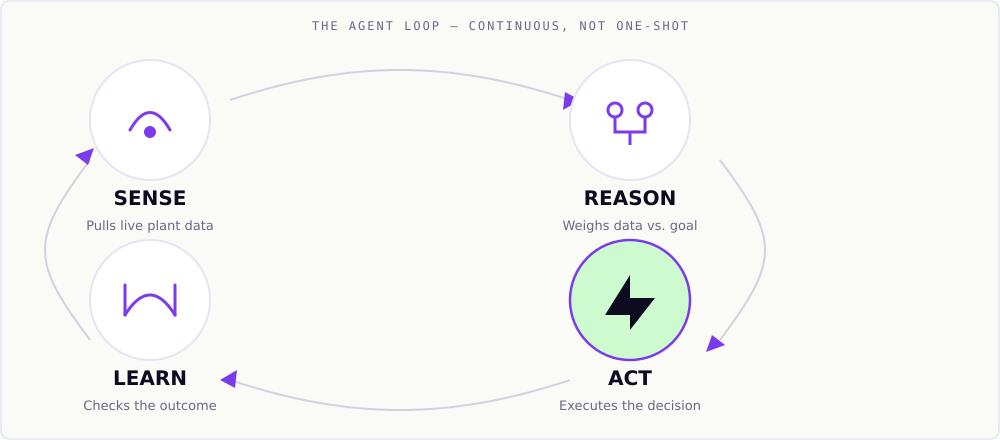
It senses — pulling live data from vibration sensors, temperature probes, PLCs, the ERP, quality cameras, maintenance logs, whatever it can reach. It reasons — weighing that data against a goal you set, like “keep this line above 85% OEE” or “don’t let raw material dip below three days of cover.” It acts — placing a reorder, nudging a machine setpoint, rescheduling a job, opening a ticket. And then it learns — checking whether the thing it did actually worked, and adjusting next time.
None of the four steps is magic on its own. Sensors have been around forever. Scheduling software isn’t new. What’s new is that a single system now handles the whole chain without kicking it back to a human at every handoff. That’s the leap. And it’s why people who saw the last three “AI is coming to manufacturing” cycles come and go are, this time, actually rearranging budgets.
Where agents genuinely pull their weight
Not every corner of a plant needs an agent. Some do, badly. Here’s where the returns are showing up first.
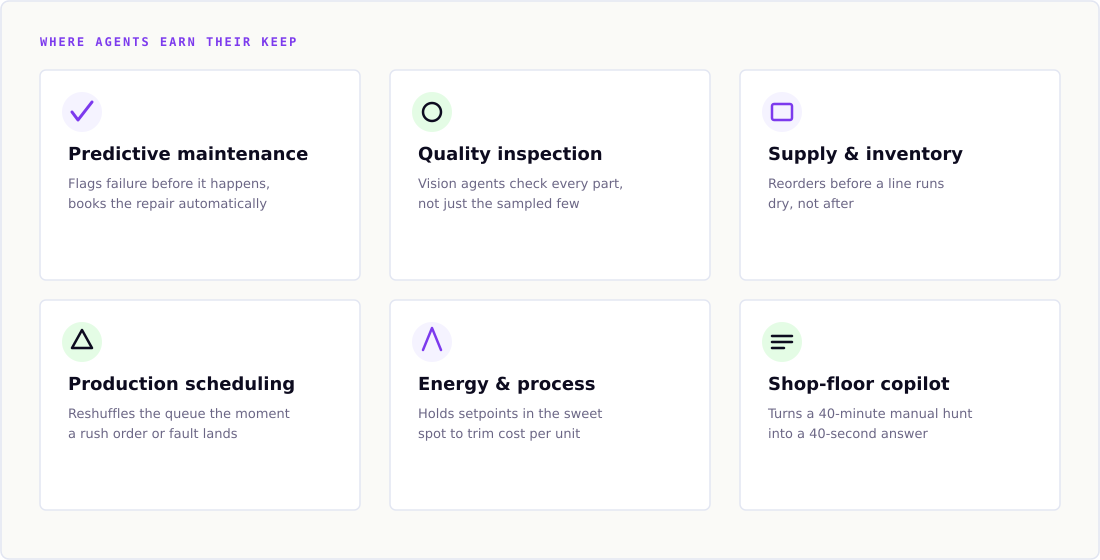
Predictive maintenance is the obvious front door. It’s where most plants start, because the pain is measurable and the win is measurable. A maintenance agent watches equipment health around the clock, flags the failure before it happens, and — this is the agentic part — actually sets the repair in motion. Plants that made this shift are reporting 30 to 50% less unplanned downtime and a quarter to 40% lower maintenance spend inside the first year. Siemens has talked about roughly 20% lower maintenance costs and 15% more uptime from this kind of program. Your mileage will vary, but the direction is consistent enough that it’s hard to wave away.
Quality inspection is the quiet overachiever. Vision agents look at every part coming down the line, not the sample the human inspector had time for, and they don’t get tired at hour seven of a shift. The reported drop in defect escape rates lands in the 40 to 60% range. If you’ve ever eaten the cost of a recall or a returned batch, you already know what one avoided escape is worth.
Supply and inventory is where the money hides. An inventory agent watches consumption in real time, sees a line about to run dry, and reorders before anyone notices a problem. Deloitte’s 2025 survey of 600 executives put the average production and supply chain efficiency gain around 34% for companies actually shipping AI into operations — not piloting it, running it. Gartner, for its part, expects 60% of companies using supply chain software to have adopted agentic features by 2030, up from about 5% in 2025. That’s a five-year runway, and the early movers get the cheap seats.
Production scheduling rounds it out. When a rush order lands or a machine drops, an agent can reshuffle the queue on the fly instead of waiting for the morning planning meeting to sort it out. Energy and process tuning trims cost per unit by holding setpoints in the sweet spot. And a shop-floor copilot — an agent that answers an operator’s “why is line 3 throwing this fault” from the manuals and the live data — turns a 40-minute hunt into a 40-second answer.
The numbers, with the caveat they deserve
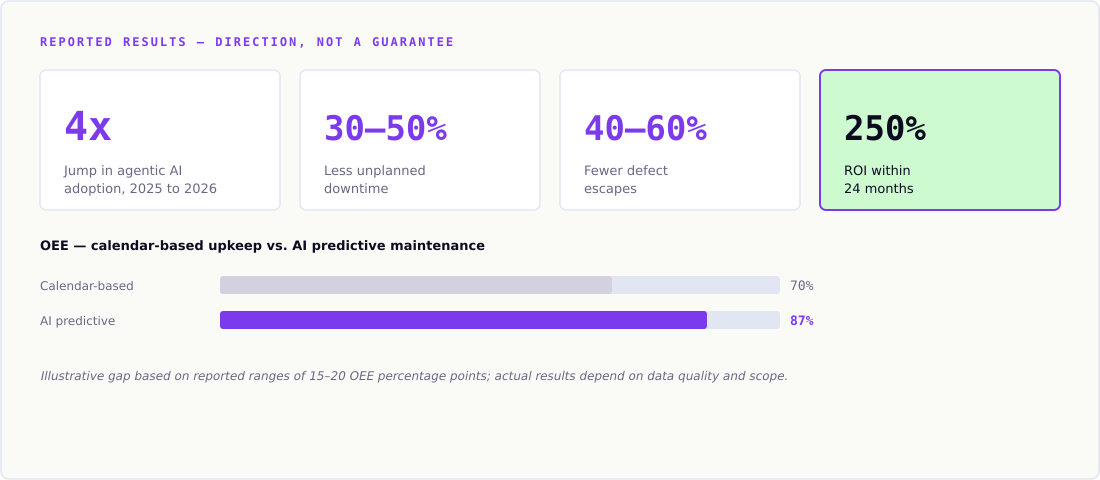
I want to be careful here, because manufacturing has been burned by vendor math before. The figures floating around — 250% ROI within 24 months, 15 to 20 percentage points of OEE improvement over calendar-based upkeep — are real reported results, but they come from plants that did the work. They aren’t a coupon you redeem at install.
What the good numbers have in common is boring: clean data, a narrow first use case, and someone who owned the outcome. The plants that bolted an agent onto messy sensor feeds and vague goals got messy results. The ones that picked a single line, fed the agent trustworthy data, and measured against a real baseline are the ones posting the eye-catching figures.
So treat the ranges as a direction of travel, not a promise. If a vendor quotes you the top of every range at once, keep one hand on your wallet.
The part nobody puts on the slide
Agents are not plug-and-play, and pretending otherwise is how pilots die.
Your data has to be worth trusting. An agent acting on garbage data makes confident, fast, wrong decisions — which is worse than a human making slow ones. Before you automate an action, you need to be honest about whether the sensor feeding it is calibrated and whether the ERP reflects reality. A lot of “AI projects” are really data-cleanup projects wearing a nicer jacket.
People need a reason to trust it. The first time an agent reorders a part or reschedules a job on its own, someone on the floor is going to be uneasy, and they should be. Good rollouts start with the agent recommending and a human approving, then loosen the leash once it’s earned trust on the low-stakes calls. Skip that and you’ll get shadow overrides — operators quietly ignoring the system — which is the same as not having it.
Guardrails aren’t optional. An agent that can act needs limits on what it’s allowed to do without a human. Reorder a $40 gasket? Fine, go ahead. Halt a line or place a $200,000 order? That should still route to a person. Define those boundaries on day one, not after the first expensive surprise.
Start small on purpose. The plants getting real value didn’t roll out a self-driving factory. They picked one painful, measurable problem — usually downtime — proved the agent could handle it, and only then let a second agent join in. Agents talking to agents is genuinely powerful, but it’s the second move, not the first.
Where this is actually heading
The honest read is that 2026 is the year agentic AI stops being a science project and starts being a competitive fact in manufacturing. Not because the technology suddenly got magical, but because enough plants have run it long enough that the playbook is now visible. The gap between the plant running AI predictive maintenance and the one still on calendar-based upkeep is already showing up as a real, double-digit OEE difference. That gap compounds.
You don’t need to boil the ocean to get on the right side of it. Pick one process where the pain is obvious and the data is decent. Put an agent on it in recommend-only mode. Measure it against a baseline you’d defend to your CFO. Give it room to act once it’s earned it. That’s the whole strategy, and it’s a lot less dramatic than the headlines suggest — which is exactly why it works.
The factories that figure this out won’t be the ones with the flashiest tech. They’ll be the ones that started early, kept it narrow, and let the results do the arguing.
Curious what an AI agent would look like on your line? The best first step is almost always the least glamorous one: pick the process that’s costing you the most sleep, and see what a well-scoped agent could do with the data you already have.
Sources: Deloitte — The agentic supply chain in manufacturing · iFactory — Agentic AI in Manufacturing (2026) · BusinessPlusAI — 10 AI Agent Use Cases for Manufacturers · ChaiOne — Agentic AI Production-Floor ROI · Tech-Stack — AI Adoption in Manufacturing: ROI Benchmarks
How we write, source and correct our articles:editorial policy.
Related reading

Agentic AI for small manufacturers: what it actually does
Agentic AI for small manufacturers: software that reads your CRM and inbox, then forecasts, replies, and scores leads. What it covers, and what it doesn't.

AI agents in the manufacturing industry: sales and marketing use cases beyond the hype
What AI agents actually do for manufacturing sales today vs. what's still overhyped — RFQ triage and lead scoring are real; autonomous negotiation isn't.

AI agents in sales and marketing: a manufacturer's guide to evaluating one
How to evaluate an AI agent for manufacturing sales and marketing: integration depth, human oversight, data security, and questions worth asking any vendor.
Ready when you are
See it read your own sales mailbox
Twenty minutes, on a real mailbox, with no slides. Gmail, Google Workspace, Outlook and Microsoft 365.