AI agents in the manufacturing industry: sales and marketing use cases beyond the hype

AI agents in manufacturing sales and marketing are real and shipping today for a specific, narrower set of jobs than the hype suggests: triaging inbound RFQs, scoring leads for trust and spam, drafting replies for human approval, and keeping forecasts current. Fully autonomous negotiation, cold outbound, and dashboards that need no clean data behind them are not there yet, regardless of what a demo implies.
This is a deliberately unglamorous list. That’s the point — the manufacturers getting real value are the ones who separated the two columns before they bought anything.
Why manufacturing sales AI gets hyped harder than it should
Shop-floor AI — predictive maintenance, quality inspection — has a few years of head start and genuinely mature results behind it. Sales and marketing AI for manufacturing is newer, and the marketing around it has outpaced what’s actually been built and proven at scale. That gap between claim and shipped reality is exactly where “beyond the hype” needs to mean something specific, not just a disclaimer.
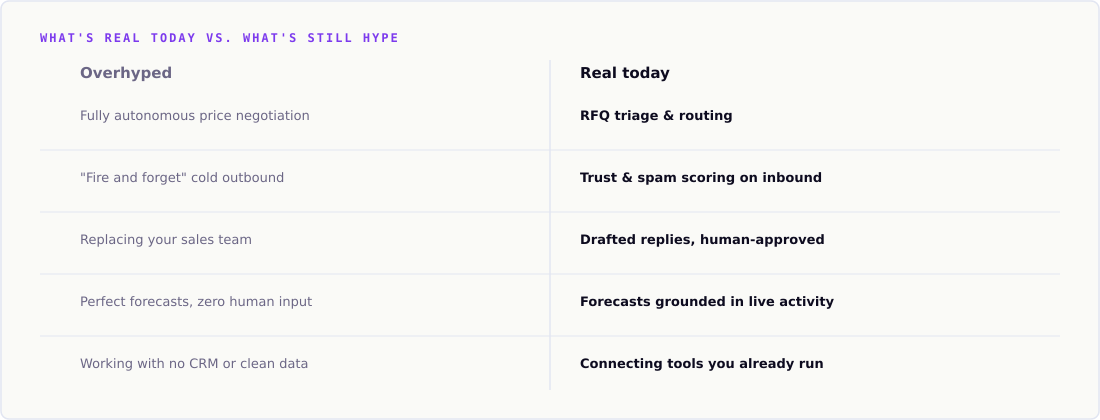
What’s actually real today
RFQ triage and routing. An inbound quote request — often an email with an attached spec sheet, not a clean web form — gets read, checked against trust signals, and routed to the right rep automatically. This is the most mature, most measurable use case, because the before-and-after is easy to see: an RFQ sitting for days versus one triaged in minutes.
Trust and spam scoring on inbound. Not every RFQ is real demand. A working system scores each inbound message for spam risk and buyer trust — separately, because a targeted invoice-fraud attempt and a legitimate cold RFQ score very differently, and blending them into one number hides exactly the cases that matter most.
Human-approved drafted replies. The agent drafts a professional first response from a rough instruction; a person reviews and sends it, at least for anything past a routine acknowledgment. This is real and working, and it’s deliberately not the same as fully autonomous sending — see below.
Forecasts grounded in live activity. Pipeline projections that update as deals actually move, instead of a spreadsheet snapshot from the last review meeting. Not predictive magic — just current data instead of stale data.
What’s still overhyped
Fully autonomous price negotiation. No system should be committing your company to pricing or terms without a person in the loop, and no credible vendor should be pitching that it does. This is a judgment call, not a triage task.
“Fire and forget” cold outbound. Sending AI-generated cold outreach at scale with no oversight is a spam and deliverability problem waiting to happen — and in B2B manufacturing specifically, where buyers are technically literate and quick to spot generic content, it tends to damage trust faster than it builds pipeline.
Replacing a sales team outright. The realistic version is fewer hours spent on triage and drafting, not fewer people needed to close deals. Manufacturing sales still runs on relationships and technical trust that a rep builds over months — software doesn’t substitute for that.
Working with no usable data. An agent reading a CRM nobody’s updated and an inbox with no history isn’t going to produce good forecasts or good scores. The output is only as good as what it has to read, same as it would be for a new hire on day one.
The honest takeaway
The manufacturers getting real value from this aren’t the ones who bought the most ambitious pitch. They picked one specific, measurable problem — usually RFQ response time — got it working reliably with a human still in the loop where it mattered, and expanded from there once the results held up. That’s a smaller, less dramatic story than the hype, and it’s the one that actually holds up under scrutiny.
Delynt AI is AI email triage and response for businesses that sell out of a shared mailbox. It connects to Gmail, Google Workspace, Outlook and Microsoft 365, drops automated junk by rule before any model runs, scores what survives for trust and spam with a written reason, and drafts and sends replies under the approval rules you set. How it works.
How we write, source and correct our articles:editorial policy.
Related reading

Agentic AI for small manufacturers: what it actually does
Agentic AI for small manufacturers: software that reads your CRM and inbox, then forecasts, replies, and scores leads. What it covers, and what it doesn't.
AI agents in sales and marketing: a manufacturer's guide to evaluating one
How to evaluate an AI agent for manufacturing sales and marketing: integration depth, human oversight, data security, and questions worth asking any vendor.

Your shop floor already trusts AI agents. Why doesn't your sales desk?
Manufacturers now run agentic AI on the production line as a matter of course. Here's why the same trust hasn't extended to the sales desk yet — and why that gap is closing fast.
Ready when you are
See it read your own sales mailbox
Twenty minutes, on a real mailbox, with no slides. Gmail, Google Workspace, Outlook and Microsoft 365.