Agentic AI for small manufacturers: what it actually does

Agentic AI for small manufacturers means software that connects to the tools you already run — your CRM, your inbox, your website analytics — and acts on what it sees, without waiting to be asked. For a five-person sales desk, that means routine triage, first replies, and pipeline tracking happening continuously in the background instead of piling up in someone’s inbox.
That’s the whole idea in one paragraph. The rest of this is what it actually covers, concretely, and — just as important — what it doesn’t.
Why “what it actually does” needs saying out loud
“Agentic AI” has become one of those phrases that gets attached to almost anything with an API call in it. For a small manufacturer trying to decide if any of this is worth their time, the vagueness is the actual barrier. Nobody signs up for “transformative AI.” People sign up for “this stops RFQs from sitting in an inbox for four days.”
So here’s the specific version, grounded in what a small manufacturing sales desk actually deals with day to day.
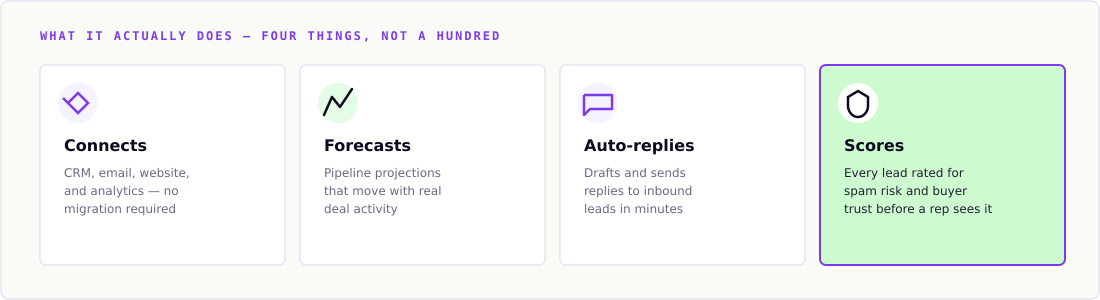
It connects to what you already run. CRM, email, website analytics — in place, without a migration. If your team already lives in Gmail and a CRM you half-trust, that’s the starting point, not something to replace first.
It forecasts from what’s actually happening. Not a spreadsheet snapshot from last week’s pipeline review — a picture that updates as deals move, so a stalling deal shows up as a signal now instead of a surprise at quarter close.
It replies to inbound leads before they go cold. A drafted, on-brand response to a routine inquiry, ready in minutes instead of whenever someone has a spare hour. Anything that needs real judgment — pricing, a custom spec — still goes to a person.
It scores every lead for trust and spam. Before a rep ever opens it, an inbound message gets rated for whether it’s a real buyer or noise, so the limited hours in a day go toward RFQs that are actually worth a callback.
What it doesn’t do
This is the part most vendor pages skip, and it’s the part that actually builds trust.
It doesn’t negotiate price or commit to terms on your behalf. Those decisions stay with a person — the agent’s job is clearing the delay before that person gets involved, not replacing their judgment.
It doesn’t work well with no data to learn from. An agent reading a CRM nobody’s updated in months, or an inbox with no history, starts from close to zero. The value compounds as real activity accumulates, not on day one.
It doesn’t eliminate the need for a sales desk. A five-person team stays a five-person team — the difference is how much of their day goes to triage versus to the calls that actually close deals.
Why small manufacturers specifically
Bigger companies have historically solved slow response times with headcount — a dedicated team whose entire job is fast triage. A small manufacturer rarely has that option. The same two or three people fielding RFQs are also running quotes and managing existing accounts. Agentic AI doesn’t add headcount; it covers more of the hours those two or three people already have.
That’s the actual case for it — not that it’s futuristic, but that it’s a cheaper, faster way to cover work that would otherwise mean hiring someone or letting leads sit.
Delynt AI is AI email triage and response for businesses that sell out of a shared mailbox. It connects to Gmail, Google Workspace, Outlook and Microsoft 365, drops automated junk by rule before any model runs, scores what survives for trust and spam with a written reason, and drafts and sends replies under the approval rules you set. How it works.
How we write, source and correct our articles:editorial policy.
Related reading

AI agents in the manufacturing industry: sales and marketing use cases beyond the hype
What AI agents actually do for manufacturing sales today vs. what's still overhyped — RFQ triage and lead scoring are real; autonomous negotiation isn't.
AI agents in sales and marketing: a manufacturer's guide to evaluating one
How to evaluate an AI agent for manufacturing sales and marketing: integration depth, human oversight, data security, and questions worth asking any vendor.

Your shop floor already trusts AI agents. Why doesn't your sales desk?
Manufacturers now run agentic AI on the production line as a matter of course. Here's why the same trust hasn't extended to the sales desk yet — and why that gap is closing fast.
Ready when you are
See it read your own sales mailbox
Twenty minutes, on a real mailbox, with no slides. Gmail, Google Workspace, Outlook and Microsoft 365.